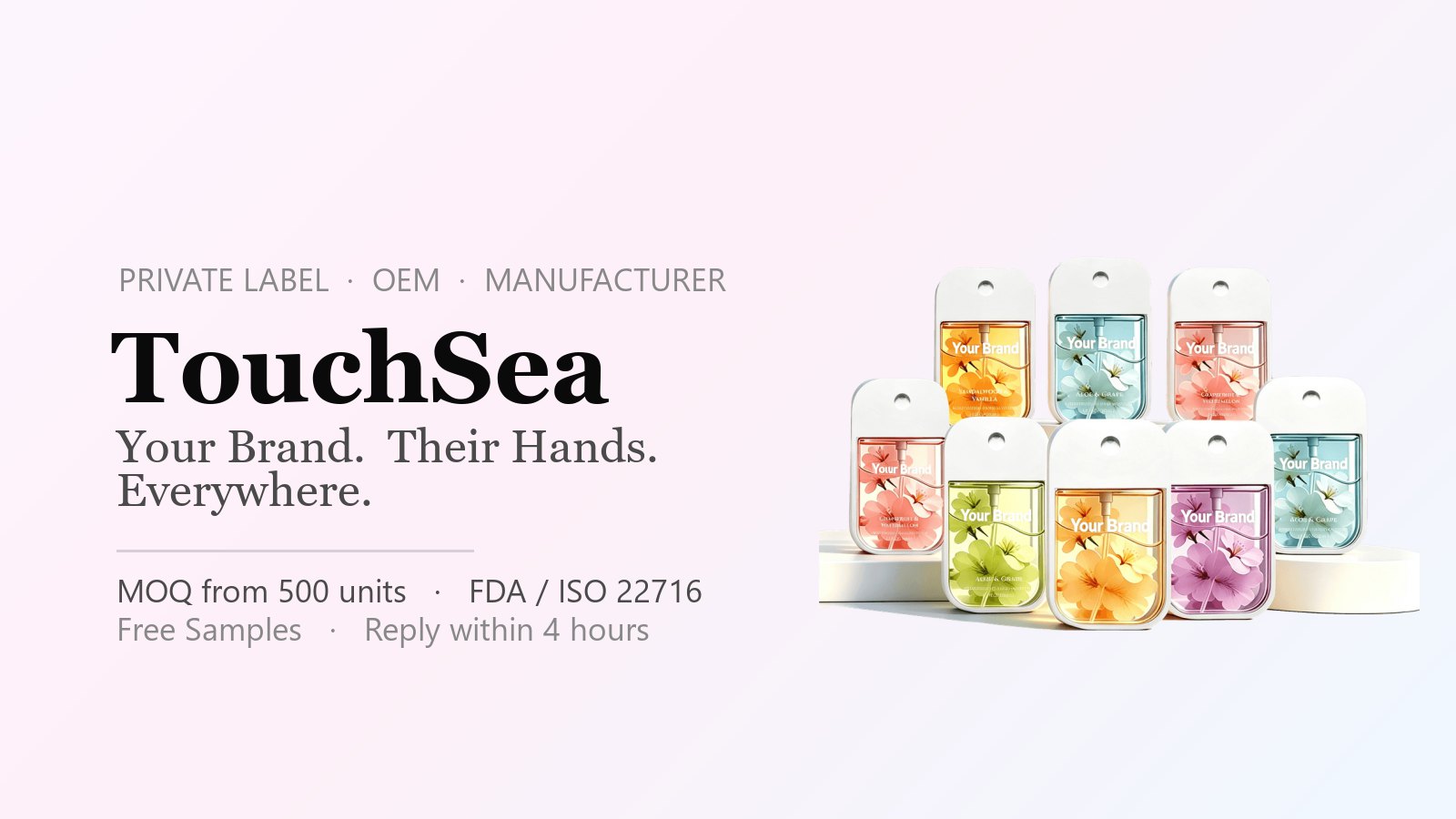
If you are sourcing hand sanitizer spray, you will often see two terms: white label and private label. Many buyers mix them up. While both let you sell products under your own brand name, they differ heavily in formula customization, production flexibility, FDA compliance, and minimum order quantity (MOQ).
What Is White Label?
White label products are pre-formulated, ready-made goods manufactured in bulk. The factory already has the full formula, packaging structure, and compliance documents. You simply add your logo and brand artwork to the existing product.
Key features of white label
- Fixed formula: The product formula, ingredients, and efficacy stay unchanged. You cannot adjust raw material ratios or scent.
- Fast lead time: Products are pre-produced or semi-finished. Only labeling is needed. Shipment turnaround is short.
- Low MOQ: Factories usually accept smaller order sizes. Perfect for new brands, retail testers, or promotional merchandise.
- Compliance: The manufacturer holds the base FDA documentation. Your brand uses the existing compliant formulation.
- Limited customization: Only print, color of label, packaging design are adjustable. Bottle shape, liquid formula remain standard.
Best for: Startups, marketing promotions, quick market testing, small retail runs.
What Is Private Label?
Private label (also known as OEM) means the manufacturer builds the product specifically for your brand. You can tailor the formula, ingredients, bottle shape, cap design, scent, viscosity, and packaging from scratch.
Key features of private label
- Custom formula: Adjust alcohol concentration, moisturizers, fragrance, and additive ingredients to meet your requirements.
- Higher MOQ: Custom mold development and raw material setup require larger minimum orders.
- Longer lead time: Tooling, formula testing, stability checks, and artwork approval add production time.
- FDA & regulatory note: When you customize hand sanitizer spray (OTC drug category in US), formulation changes may trigger new FDA review work. This is a critical point many importers overlook.
- Full ownership: Your brand owns the unique formulation and packaging design after production.
Best for: Established retailers, brand owners, large distributors wanting unique product differentiation.
Side-by-Side Comparison Table
| Item | White Label | Private Label |
|---|---|---|
| Formula | Pre-made, fixed | Fully customizable |
| Customization | Only label & print | Formula, bottle, cap, packaging, scent |
| MOQ | Low | High |
| Production Lead Time | Short | Long |
| FDA Work | Use existing approved formula | Custom formula needs extra compliance validation |
| Cost per unit | Lower base cost | Higher due to R&D & setup fees |
| Product Uniqueness | Same base product as other brands | Exclusive formulation for your brand |
How to Choose Between White Label and Private Label for Hand Sanitizer Spray
Choose White Label if:
- You want to launch quickly and test market demand
- You have limited budget and small order volume
- You do not need a unique formula, just branded packaging
- Promotional gifts, event giveaways, short-term retail campaigns
Choose Private Label if:
- You need a unique formula (special scent, extra moisturizer, specific alcohol content)
- You want exclusive packaging shapes to stand out from competitors
- You are a large distributor with stable, bulk orders
- Your brand needs differentiated selling points for retail shelves
Common Pitfall: FDA Compliance for Hand Sanitizer
Hand sanitizer spray is classified as OTC drug by FDA in the US, not cosmetic.
- White label: Confirm the factory’s existing formula is FDA-compliant before purchasing. You cannot alter the formula freely.
- Private label: Any change to active ingredients or formula may require new compliance verification. Do not customize formulation without consulting your manufacturer’s regulatory team.
Final Takeaway
White label is the fast, low-risk entry option using a ready-made product. Private label gives you full control over formula and packaging, at higher MOQ and longer timelines. For hand sanitizer spray buyers, FDA compliance should always be the top consideration, no matter which model you pick.
FAQ
Q1: Can I change the scent on white label hand sanitizer spray?
A: Normally no. White label uses a fixed pre-made formula. Scent changes belong to formulation customization, which falls under private label work.
Q2: Does private label mean I get FDA registration under my brand name?
A: Not automatically. FDA OTC hand sanitizer registration depends on formulation responsibility. Discuss registration assignment with your manufacturer in advance.
Q3: Which one is cheaper, white label or private label?
A: White label usually has lower unit cost and no tooling/R&D setup fees. Private label incurs mold and formula development charges.