Summary: Hand sanitizer is more than a pandemic leftover — it's a $12B category growing at 8% CAGR. For private label brands, understanding the product category, formula types, and regulatory landscape is the first step to launching a profitable SKU. This guide covers everything a brand owner needs to know.
Primary keyword: what is hand sanitizer
1. What Is Hand Sanitizer, Exactly?
Hand sanitizer is a liquid, gel, or foam formulation designed to reduce infectious agents on the hands when soap and water are not available. At its core, every effective sanitizer contains an antimicrobial active ingredient — almost always ethyl alcohol (ethanol) or isopropyl alcohol (isopropanol) — at a concentration high enough to kill bacteria and many viruses on contact. In the United States the FDA classifies alcohol-based hand sanitizers as over-the-counter (OTC) drugs, while the World Health Organization publishes standard formulations built around 80% ethanol or 75% isopropanol.
But alcohol is only half the story. The remaining 20–40% of the formula is what separates a usable product from a forgettable one: purified water, humectants such as glycerin or aloe to counteract dryness, and sometimes a fragrance or skin-conditioning additive. Understanding this split — active versus supporting ingredients — is the single most important concept for any brand owner evaluating a formula sheet or an OEM sample.
For private label brands, "hand sanitizer" is not one product but a platform. The same active can be delivered as a thick gel, a fine mist spray, or a light foam, each with different packaging, cost, and consumer perception. The rest of this guide breaks down those choices so you can brief a manufacturer with confidence.
2. The Three Main Types: Gel, Spray, and Foam
Most first-time brand owners assume "hand sanitizer" means the gel they kept in their car in 2020. In reality there are three distinct delivery formats, and the format you choose drives your packaging cost, your regulatory pathway, and how premium your brand feels on a shelf.
| Format | Texture | Best for | Typical package | Perception |
|---|---|---|---|---|
| Gel | Viscous, clear or tinted | Everyday, family, bulk | Pump or flip-top bottle | Familiar, value |
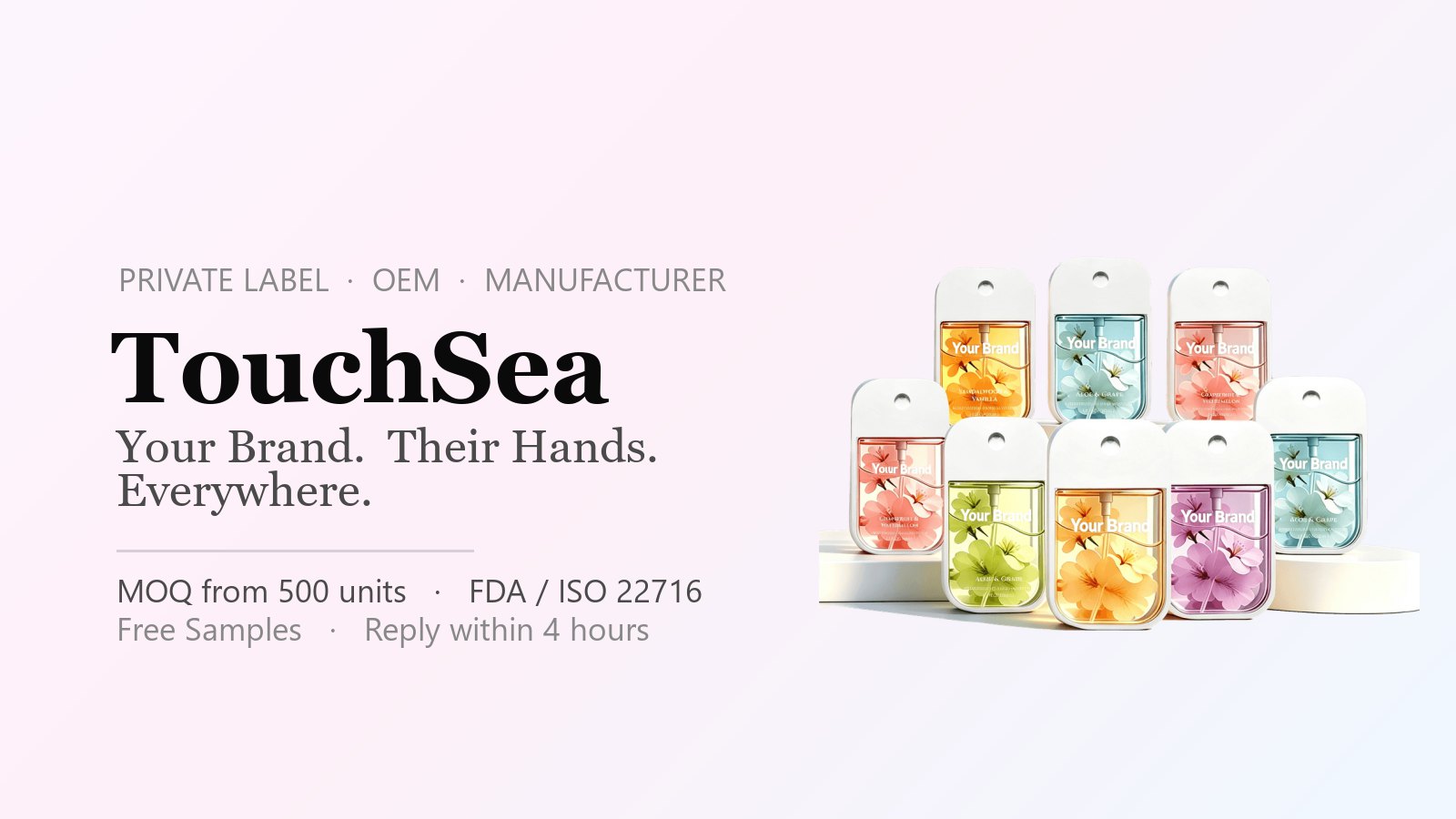
| Spray | Fine mist | On-the-go, premium, surfaces | Mist sprayer | Modern, hygienic |
| Foam | Light lather | Restrooms, schools, clinics | Foam pump | Professional, low-mess |
Gel is the lowest-risk entry point: consumers recognize it, tooling is cheap, and fill lines are standard. Spray positions your brand as premium and is the format our Mockup Studio most often renders for launch campaigns. Foam is niche but wins in high-traffic institutional placements where dripping is a problem. We cover the gel-vs-spray trade-off in depth in the next article — for now, just know the three exist and that your "format decision" is really three decisions in one: packaging, experience, and price point.
Foam, while excellent in restrooms and clinics, carries the highest per-unit package cost and the slowest fill speed, which is why we treat it as a specialist format rather than a default launch SKU. Most private label programs therefore start with gel or spray and add foam only when they have a clear institutional or hospitality channel already lined up.
3. Why Hand Sanitizer Is Here to Stay
If you launched a brand in 2020 you rode a spike. If you launch in 2026 you're riding a habit. The category is worth roughly $12 billion globally and is growing at about 8% CAGR — not because of another pandemic, but because hand hygiene migrated from "hospital behavior" to "daily behavior." Travel, gyms, schools, offices, and restaurants now keep sanitizer at the point of need by default.
Three structural shifts make this durable. First, institutional demand — facilities management now treats sanitizer dispensers like soap dispensers: a permanent line item. Second, carry-on culture — travelers pack a TSA-friendly bottle the way they pack a phone charger. Third, private label momentum — retailers and DTC brands want their own SKU rather than a national brand's, which is exactly where an OEM partner fits.
For a brand owner this means the question is no longer "will people buy sanitizer?" but "why should they buy yours?" The answer lives in the choices earlier in this guide: format, fragrance, skin feel, and packaging. A category this size rewards differentiation, not me-too products.
Independent retail data shows sanitizer now appears in roughly 7 of 10 checkout-adjacent impulse sets in pharmacies across North America and Europe — a placement that simply did not exist before 2020. That shelf real estate is now permanent infrastructure, and it is exactly the kind of baseline demand that makes a private label SKU a low-risk addition to an existing personal-care or travel line. The brands that win are the ones that treated 2020 as a starting line, not a peak.
4. What Makes a Good Hand Sanitizer?
A good sanitizer does two jobs at once: it kills pathogens and it feels good enough that people actually use it daily. Miss either half and the product fails in the market.
The efficacy half is governed by alcohol concentration. Below the regulatory floor (about 60% ethanol / 70% isopropanol in the US, similar thresholds elsewhere) the product simply doesn't work reliably. But more is not automatically better — concentrations above ~95% can be less effective because a small amount of water is required for the alcohol to properly denature proteins. The sweet spot most premium brands land on is 70%, which balances kill rate with skin tolerance.
The "use it daily" half is governed by supporting ingredients. Ethanol strips the skin's natural oils, so without a humectant like glycerin or aloe, repeated use causes cracking — the #1 complaint in every review section. A well-built formula pairs the active with a moisturizer, keeps the fragrance subtle (or omit it for sensitive-skin SKUs), and avoids banned additives. When you evaluate an OEM sample, don't just smell it; check the formula sheet for the humectant level and the absence of methanol or triclosan.
As a rule of thumb, a formula that lists glycerin among its top three supporting ingredients and declares its alcohol percentage explicitly is already ahead of most marketplace listings. The brands that win repeat purchases are rarely the ones with the highest alcohol claim — they are the ones whose product people forget they are using because it never makes their hands hurt. That quiet loyalty is worth more than any number printed on the bottle.
5. How to Read a Hand Sanitizer Label
The label is where compliance and marketing meet — and where most first-time importers get tripped up. Before you approve artwork, learn to read one like a buyer, a regulator, and a competitor would.
Active ingredient & percentage. This must state the alcohol type and concentration (e.g., "Ethyl alcohol 70% v/v"). If it's missing or vague, the product is not compliant in the US, EU, or most of Asia.
Drug facts / warnings. In the US, OTC sanitizers carry a Drug Facts panel: uses, warnings ("keep away from fire"), and instructions. In the EU it's different — a cosmetics-style label with required hazard statements. Know which regime your target market uses.
Net content & responsible party. The volume (e.g., 59 ml / 2 fl oz) and a US/EU contact address are mandatory.
Claims discipline. "Kills 99.9% of germs" is supportable; "protects against all viruses" is not. Over-claiming triggers warning letters and customs holds.
Reading labels well protects your brand and shortens retail approval. When your OEM sends a proof, read it line by line — or let our team review it for free before you pay (see the label artwork guide in week 4).